Infertility affects millions of couples worldwide, and male factor infertility contributes to nearly half of all infertility cases. Fortunately, advances in assisted reproductive technology (ART) have made parenthood possible for many couples who previously had limited treatment options.
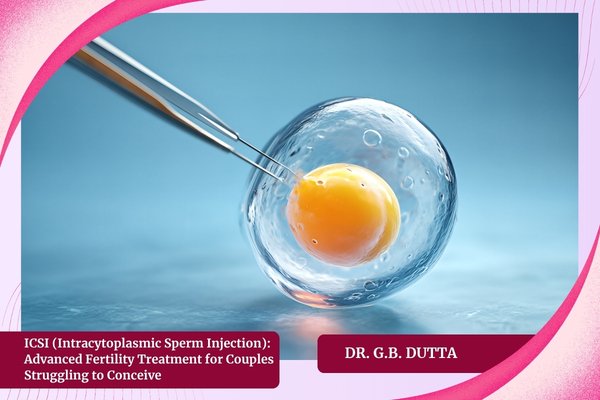
Intracytoplasmic Sperm Injection (ICSI) is one of the most advanced and successful fertility treatments available today. It is a specialized IVF technique in which a single healthy sperm is directly injected into an egg to facilitate fertilization.
Under the expert guidance of Dr. G.B. Dutta at East End Fertility Clinic, couples receive personalized fertility evaluation and advanced reproductive treatments designed to maximize their chances of achieving a successful pregnancy.
________________________________________
What is ICSI (Intracytoplasmic Sperm Injection)?
ICSI is a highly specialized laboratory procedure performed as part of an IVF cycle.
In natural conception, a sperm must travel through the female reproductive tract and penetrate the egg on its own. In certain infertility conditions, this process becomes difficult or impossible.
During ICSI:
1. Eggs are collected from the female partner.
2. A semen sample is obtained from the male partner.
3. Embryologists select a healthy sperm.
4. A single sperm is directly injected into the egg using specialized microscopic equipment.
5. Successfully fertilized embryos are cultured in the laboratory.
6. The healthiest embryo is transferred into the uterus.
ICSI significantly improves fertilization rates in selected infertility cases.
________________________________________
When Should You Seek Treatment?
ICSI may be recommended if you have been unable to conceive despite regular unprotected intercourse for one year or more.
Common Conditions That May Require ICSI
Male Factor Infertility
• Low sperm count
• Poor sperm motility
• Abnormal sperm morphology
• Obstructive azoospermia
• Non-obstructive azoospermia (selected cases)
Previous IVF Fertilization Failure
ICSI may improve fertilization outcomes when conventional IVF has been unsuccessful.
Surgical Sperm Retrieval Cases
ICSI is often required when sperm are obtained through procedures such as:
• TESA
• PESA
• Micro-TESE
Unexplained Infertility
Selected couples with unexplained infertility may benefit from ICSI.
Frozen Egg Fertilization
ICSI is commonly used with cryopreserved oocytes.
When to Consult a Fertility Specialist
• Inability to conceive after one year
• Recurrent IVF failure
• Known male infertility issues
• Previous reproductive challenges
• Advanced maternal age
• History of reproductive disorders
________________________________________
Why is ICSI Recommended?
ICSI has revolutionized infertility treatment by overcoming many barriers to fertilization.
Benefits of ICSI
Higher Fertilization Rates
Direct sperm injection helps increase the likelihood of successful fertilization.
Effective Treatment for Male Infertility
ICSI offers hope for couples affected by severe male factor infertility.
Useful in Complex Fertility Cases
The technique can overcome several fertilization challenges that conventional IVF may not address.
Improved Use of Retrieved Sperm
Even very limited sperm samples can often be utilized effectively.
Increased Pregnancy Opportunities
ICSI has helped countless couples achieve successful pregnancies and healthy births.
Compatible with Advanced Fertility Treatments
ICSI can be combined with:
• IVF
• Embryo freezing
• Blastocyst culture
• Genetic testing of embryos (PGT)
________________________________________
Risks and Complications
ICSI is generally considered safe and effective. However, like all fertility treatments, certain risks should be understood.
Potential Risks
Fertilization Failure
Although uncommon, not every injected egg will fertilize successfully.
Multiple Pregnancy
If more than one embryo is transferred, twin or multiple pregnancies may occur.
Ovarian Hyperstimulation Syndrome (OHSS)
This may occur due to fertility medications used during the IVF cycle.
Miscarriage
The risk is generally related to maternal age and embryo quality.
Emotional and Financial Stress
Fertility treatment can be physically, emotionally, and financially demanding.
Important Consideration
The success of ICSI depends on multiple factors, including:
• Female age
• Egg quality
• Sperm quality
• Uterine health
• Embryo quality
• Overall reproductive health
________________________________________
Frequently Asked Questions (FAQ)
What is the difference between IVF and ICSI?
In conventional IVF, sperm and eggs are placed together in a laboratory dish and fertilization occurs naturally. In ICSI, a single sperm is directly injected into the egg.
Is ICSI only used for male infertility?
No. Although commonly used for male factor infertility, ICSI may also be recommended for previous IVF failures, frozen eggs, and certain unexplained infertility cases.
Is the ICSI procedure painful?
The laboratory fertilization process itself is not painful. Egg retrieval is performed under anesthesia or sedation.
What is the success rate of ICSI?
Success rates vary depending on age, fertility diagnosis, embryo quality, and overall reproductive health.
Can ICSI improve pregnancy chances?
ICSI improves fertilization rates in appropriate cases, which may increase the likelihood of achieving pregnancy during IVF treatment.
Are babies born through ICSI healthy?
Most babies born through ICSI are healthy and develop normally. Fertility specialists carefully evaluate each case and monitor treatment closely.
How many eggs are needed for ICSI?
The number varies among patients. Your fertility specialist will determine the best approach based on ovarian reserve and treatment goals.
________________________________________
About Dr. G.B. Dutta
Dr. G.B. Dutta
MBBS, MD
Consultant Gynecologist, Endoscopic Surgeon & IVF Specialist
East End Fertility Clinic
Dr. G.B. Dutta is a highly experienced fertility expert specializing in infertility treatment, IVF, ICSI, reproductive medicine, and advanced endoscopic gynecological procedures. With a patient-centered approach and extensive expertise in assisted reproductive technologies, he is dedicated to helping couples achieve their dream of parenthood through personalized fertility care.
________________________________________
Call to Action (CTA)
Infertility can be emotionally challenging, but advanced reproductive technologies have created new possibilities for couples seeking to build a family.
If you are facing fertility challenges or have been advised to consider IVF or ICSI treatment, schedule a consultation with Dr. G.B. Dutta at East End Fertility Clinic. Expert evaluation and personalized fertility care can help bring you one step closer to parenthood.
________________________________________